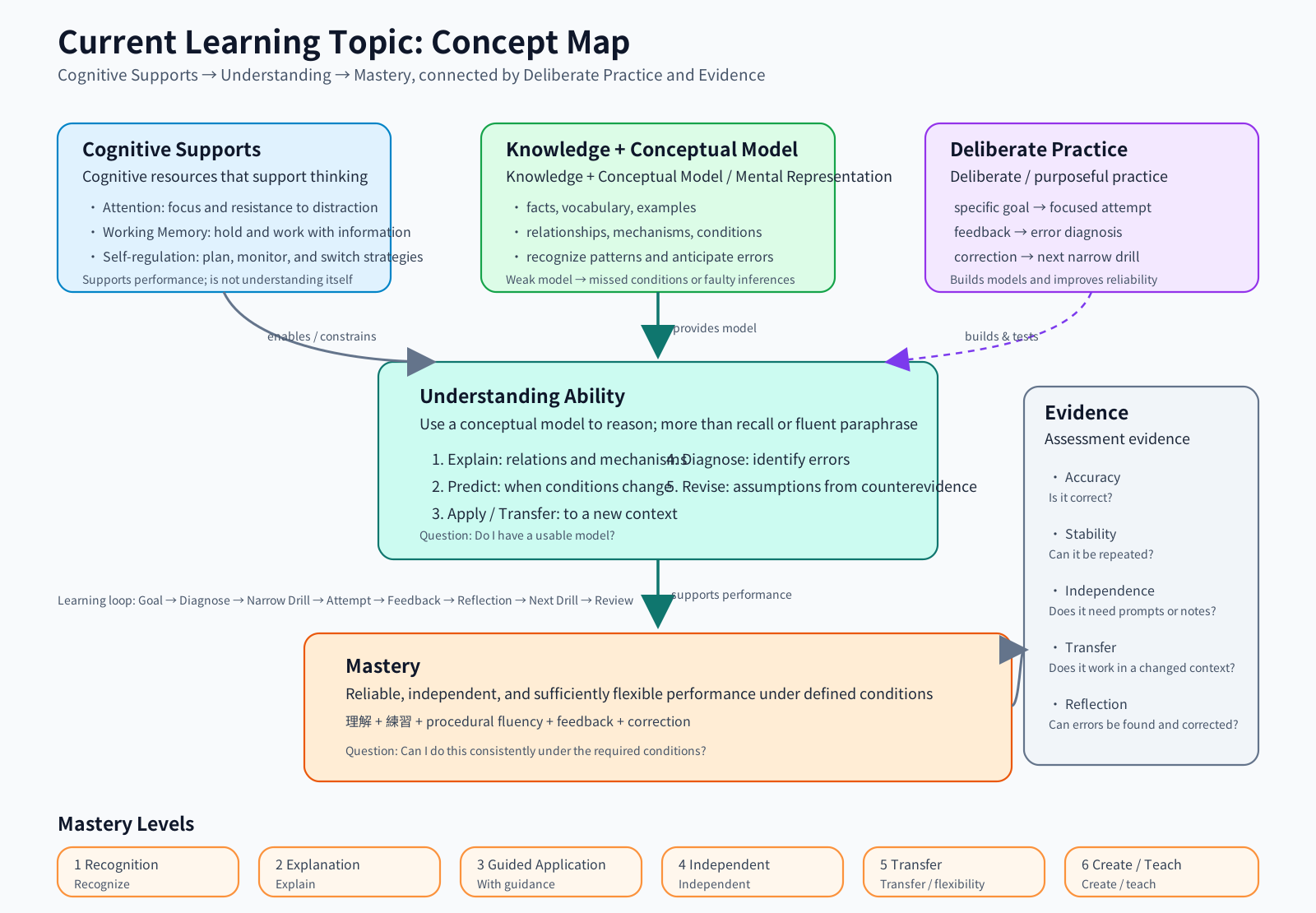
Current Learning State
learner-context record: Current Learning State.
Chinese version: /zh-hant/context/learning-state/
Last updated: 2026-09-16
Keep this concise. It is the LLM’s current navigation panel, not a full diary.
Active objective
Develop a practical model of understanding and its cognitive supports: distinguish recall from causal/model-based reasoning; distinguish attention, working memory, and self-regulation from understanding itself; state conditions behind claims; and test the model in unfamiliar cases.
Current status
- The learner completed a short guided diagnostic using Newton’s second law and everyday causal claims.
- The active learning path and first drill are recorded in Goal Breakdown and Practice Drill: Conditional causal claims.
- The learner requested a term-by-term reality mapping for the workspace’s practical definition of knowledge. The bilingual explanation is stored in Knowledge: a working map; independent classification or application of the definition remains unverified.
High-signal evidence
Secure / promising
- With net force held constant, the learner correctly derived
a = F/mand concluded that a lower mass has greater acceleration. - The learner correctly inferred that doubling mass halves acceleration when net force is unchanged.
- The learner distinguished mass from force: a heavier object does not automatically receive less force; for equal acceleration, it requires a greater net force.
- The learner identified that supply alone cannot determine price when demand also changes.
- The learner identified that study time is only one among many factors affecting academic performance.
- In the first drill attempt, the learner named learning method, physical condition, planning, and review/reflection as conditions that can prevent extra time from improving grades, then stated a matching positive conditional claim and selected experimental papers as an external evidence route.
- The learner judged that neither an unexplained correct prediction nor an explanation that fails in a new situation is sufficient for robust understanding.
- The learner does not yet distinguish cognitive supports (attention and working memory) from demonstrated understanding ability; this has become the immediate teaching target.
- The learner requested and received a working distinction between ability in general and understanding ability; independent retrieval/application remains unverified.
Fragile / not yet demonstrated
- Independently formulating a precise definition of understanding across multiple domains.
- Calibrating causal language: distinguish “necessary,” “sufficient,” “likely,” and “guaranteed.”
- Designing a valid personal test that separates an intervention effect from changes in topic difficulty or assessment conditions.
- Applying the framework without scaffolding to unfamiliar examples and revising a model after counterevidence.
- Distinguishing a cognitive-support limitation (e.g., attention or working-memory load) from an understanding/knowledge-model limitation.
Current working model
A robust understanding is not mere recall or fluent paraphrase. It should support: explanation, prediction, application/transfer, and inspection or revision of assumptions when conditions change. This is a working model to be tested further, not yet a mastery claim.
A practical hierarchy now separates recognition, explanation, guided application, independent proficiency, transfer/flexible mastery, and creation/teaching. Mastery should be recorded only against a defined task context and supported by evidence of accuracy, stability, independence, transfer, and error correction. The learner has received this framework but has not yet independently applied it to classify examples.
Cognitive-support versus understanding checkpoint
The learner was asked to compare: (A) strong concentration and memory with only definition recall; (B) ordinary memory with causal explanation and application to new examples. The learner initially answered “不知道.” The summary answer has been provided: B demonstrates stronger topic-specific understanding; A demonstrates the named concentration/memory supports; neither person’s overall cognitive ability can be ranked from the short description. Independent retrieval remains unverified. A distilled working note has been created at Cognitive supports versus understanding ability.
Immediate next action
The learner has received the distinctions between cognitive supports and understanding ability, and between understanding and mastery. Next, complete Practice Drill: Cognitive supports versus understanding and Practice Drill: Classify understanding and mastery levels without notes. Then diagnose one real learning difficulty as primarily missing knowledge/model, cognitive load, or both.
Linked evidence
- Raw learner reasoning: Thinking: What counts as understanding?
- Drill: Practice Drill: Conditional causal claims
- Initial feedback: Feedback: Initial diagnostic on understanding
- Reflection: Reflection: Initial session on understanding
- Distilled note: Understanding as a working model
- Experimental evidence note: Experimental evidence relevant to study conditions
- Cognitive-support distinction: Cognitive supports versus understanding ability
- Ability definition: Ability and understanding ability
- Vocabulary framework: Understanding a word or idiom
- Next drill: Practice Drill: Cognitive supports versus understanding
- Mastery framework: Understanding and mastery
- Connected concept map: Learning concept map: from cognitive supports to mastery and
../Diagrams/2026-09-11-learning-concept-map.svg - Chunked example guide for quick re-entry: Learning concept map explained in blocks: pick it up with examples anytime
- Mastery-level drill: Practice Drill: Classify understanding and mastery levels