Learning concept map explained in blocks: pick it up with examples anytime
knowledge record: Learning concept map explained in blocks: pick it up with examples anytime.
Chinese version: /zh-hant/knowledge/learning-concept-map-explained/
Purpose: Read this map in independent blocks. On a review, begin with the 30-second pick-up and move to the block you need.
Status: Working guide. It organises the concepts discussed so far; it does not establish mastery.
Created: 2026-09-11
Full map:
../../Diagrams/2026-09-11-learning-concept-map.svg
Text map: Learning concept map: from cognitive supports to mastery
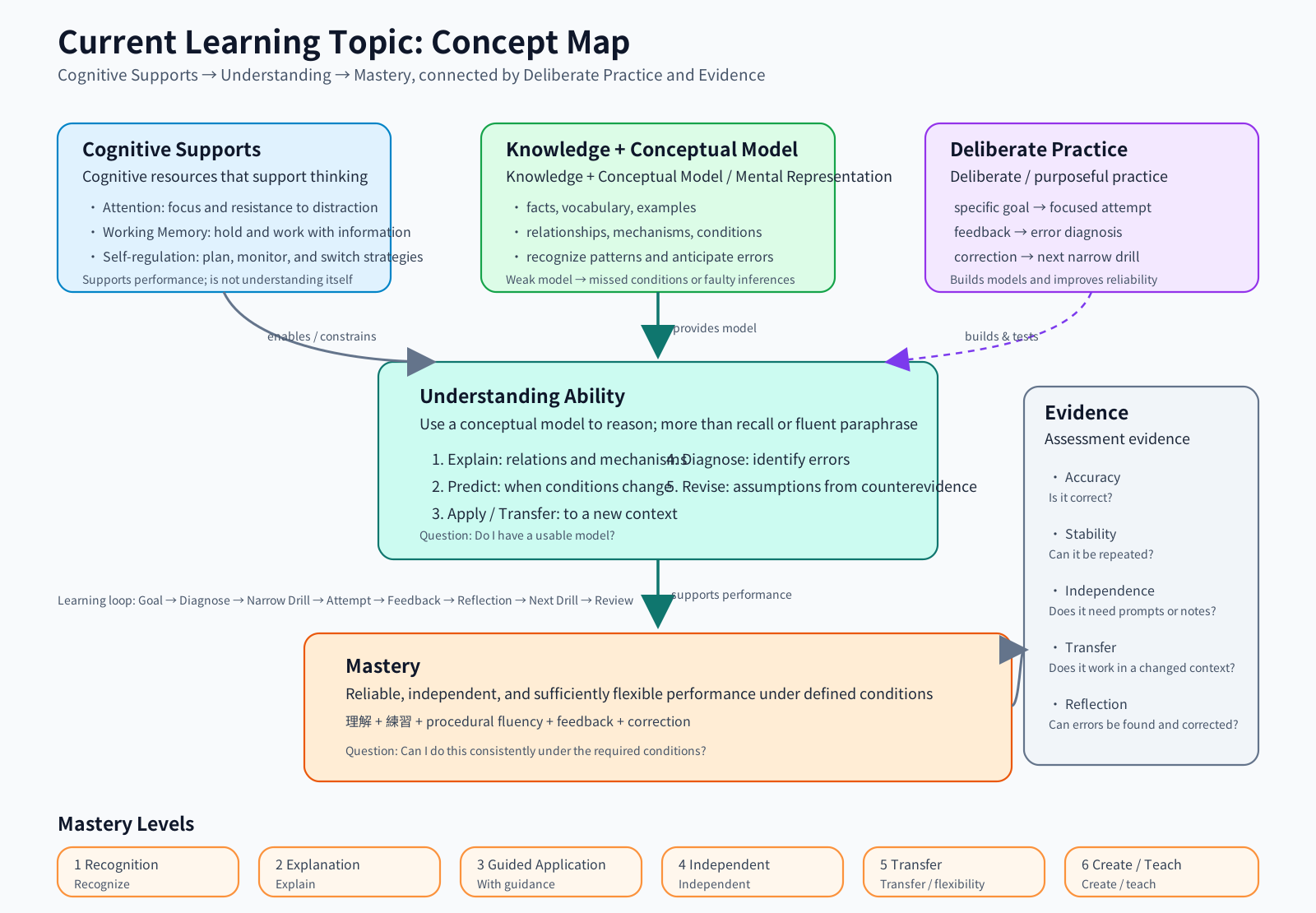
0. 30-second pick-up: what does the whole map say?
1
2
3
4
5
6
7
8
9
10
11
Cognitive supports (conditions for processing information)
          +
Knowledge + conceptual model (what you know and how it connects)
          +
Practice + feedback (how weak points become stronger)
          ↓
Understanding (explain, predict, apply, revise)
          ↓
Mastery (reliable, independent, flexible performance in a defined task)
          ↓
Check evidence: correct? stable? unprompted? transferable? can errors be repaired?
Cognitive supports give room to think; knowledge and models tell you how to think; practice and feedback improve accuracy; understanding lets you explain, infer, and use; mastery lets you perform reliably.
Block A — Cognitive supports: the working environment for thinking
A1. What are they?
Cognitive supports are abilities or conditions that help you process information; they are not themselves proof that you understand the content.
| Concept | Plain description | Role in learning |
|---|---|---|
| Attention | Direct attention to important information | Reduces distraction and helps you follow steps |
| Working memory | Temporarily hold and operate on information | Compare conditions and perform multi-step reasoning |
| Self-regulation / executive control | Manage your learning process | Plan, monitor, stop an unhelpful method, and change strategy |
A2. Everyday example
The same net force pushes two carts. A is lighter, and B has twice A’s mass. Which has greater acceleration?
- Attention: notice the condition “the same net force”; do not assume “heavier” means “less force.”
- Working memory: retain
a = F/m, thatFis fixed, and thatmchanges. - Self-regulation: if unsure, pause, rewrite the relation, and check for an omitted condition.
These actions make reasoning possible but do not guarantee understanding of Newton’s second law.
A3. Common confusion
“I focus well and have a good memory, so I must understand well.”
Attention and memory help understanding, but are not evidence of understanding by themselves.
- A quickly recites
F = maand remembers its definition. - B has ordinary memory but explains that, with net force unchanged, doubling mass halves acceleration; if friction changes, net force must be reconsidered.
B has stronger evidence of topic-specific understanding. A demonstrates memory and concentration supports. This small case cannot rank either person’s overall intelligence.
A4. When to use this block
Check cognitive supports when you think: “I have seen this but get jammed in a problem,” “I forget the beginning of a long question,” “I skip conditions,” or “I cannot do it after interruption.”
Am I missing a conceptual model, or is task load overwhelming my working memory or attention?
Block B — Knowledge + conceptual model: the usable map in your mind
B1. Knowledge is not a conceptual model
- Knowledge: facts, vocabulary, formulae, examples, and rules.
- Conceptual model: the structure connecting them: what affects what, under which conditions, and why.
Words, formulae, and rules are place names on a map; a conceptual model is the roads, directions, terrain, and relations for reaching a destination.
B2. Supply and price
“Lower supply means higher prices.”
This is knowledge but may be too crude. A more usable model is: prices are jointly affected by supply and demand; lower supply usually pushes prices up, but a sharp fall in demand may prevent that result.
This adds a key variable (demand), conditional language (usually, if, may not), and a structure for predicting new cases.
B3. Mental representation
A mental representation is a compressed, organised map of a situation. A novice may see “supply, demand, price, inventory, buyers.” Someone with a model may see “supply and demand both change, so consider their directions separately.” This is built through targeted examples, feedback, comparison, and revision, not mysterious talent.
B4. When to use this block
The model may be weak when you can memorise a definition but not see what a question asks, treat changed wording as new knowledge, remember only an answer, or treat a counterexample as destroying a rule instead of revealing an omitted condition.
Am I missing a fact, or a causal/conditional model that connects facts?
Block C — Understanding ability: can the model be used?
C1. Simplest definition
Understanding is not merely finding an explanation plausible or repeating a definition. It is using a model to handle change.
1
Explain → Predict → Apply / Transfer → Diagnose → Revise
C2. Study time and grades
1. Explain
“The longer you study, the better your grades” is not necessarily an explanation because it gives no mechanism or conditions. A better explanation says additional effective time may improve performance through practice, retrieval, and feedback, while method, rest, prior knowledge, attention, and alignment with assessment also matter.
2. Predict
If two more hours involve only rereading, no retrieval practice, and severe fatigue, grades will not necessarily improve; added time may not become effective learning.
3. Apply / transfer
More tutorial watching does not necessarily improve coding. Implementation, errors, feedback, and later independent completion of a small task matter more than viewing time alone.
4. Diagnose
If performance does not improve after two weeks, ask whether method matched the goal, practice remained reading, difficulty changed, sleep or attention changed, or delayed retrieval was checked.
5. Revise
Replace “If I spend more time, I should improve” with: “When the method is effective, concentration is possible, material matches assessment, and feedback plus review occur, additional time is more likely to improve performance.”
C3. Quick check
If I answer only familiar examples, I may have recall or guided application. If changed conditions still allow explanation, prediction, and revision, I have stronger evidence of understanding.
Block D — Deliberate practice: turning knowing into doing
D1. Why repetition alone is insufficient
Repetition can become: same problem type → familiar format → same move → no knowledge of where the error occurred. It can produce familiarity without a better model or transfer.
Deliberate / purposeful practice targets one specific weakness at a time, requires concentration, receives feedback, and then revises.
D2. Mini-case: distinguish understanding and mastery
The goal “I want to understand learning theory” is too vague to practise. A narrow drill is: read four cases and decide whether each shows understanding, mastery, the highest justified level, and why a higher level is not justified.
If you classify ten correct standard questions directly as transfer, feedback should identify the earliest failure: they may share one familiar format and show no changed condition or choice of method. They support independent proficiency, not transfer.
The next drill compares only: A, ten same-type questions without prompts; B, one unfamiliar situation requiring independent method choice and stated conditions.
D3. The loop
1
Goal → diagnose → narrow drill → attempt → feedback → reflection → next drill → review
Feedback identifies the earliest failed step. Reflection distinguishes knowledge, conditions, strategy, and cognitive load. Delayed review prevents familiarity from being mistaken for learning.
Block E — Mastery: what is real mastery?
E1. Not one correct answer
Mastery means, within a clearly defined task range, performing accurately, consistently, independently, and flexibly when needed. One correct answer is at most one positive piece of evidence.
E2. Example: maintain
| Situation | What it represents |
|---|---|
| You recognise maintain as roughly “keep” | Recognition |
| You say “keep something at a level or condition” | Understanding / explanation |
| You complete maintain a healthy lifestyle with a prompt | Guided application |
| You naturally write maintain service quality in an email | Independent proficiency |
| You distinguish maintain, sustain, and preserve in new sentences | Transfer |
| You explain collocations, tone, and common misuse | Creation / teaching |
E3. Mastery has scope
Do not say abstractly, “I have mastered English.” Say, for example: “I can use this word set independently and accurately in ordinary work emails; I do not yet have enough transfer evidence in formal negotiation or literary writing.”
Mastery of which task, under which conditions?
Block F — Mastery levels: from exposure to teaching
| Level | Meaning | Example: causal claim |
|---|---|---|
| 1. Recognition | Recognise it, but may not use it | You recognise “correlation is not causation” |
| 2. Explanation | State its meaning and reason | Explain that a third factor may account for correlation |
| 3. Guided application | Use it with a prompt | Identify a confounder after being prompted |
| 4. Independent proficiency | Complete ordinary tasks independently and reliably | Find omitted conditions in familiar everyday claims |
| 5. Transfer / flexible mastery | Use it in changed contexts or tasks | Choose causal analysis in health, economics, and work decisions |
| 6. Creation / teaching | Compare, improve, and teach | Design a small experiment and diagnose an argument |
Level 2 means you can talk about causal relations. Level 4 means you independently look for conditions, variables, comparison groups, and evidence limits. Level 4 works in familiar problem types; Level 5 continues to work when wording, context, and method choice change.
Block G — Evidence criteria: do not be fooled by “feeling like I understand”
| Criterion | Question | Example |
|---|---|---|
| Accuracy | Is it correct? | Doubling mass with unchanged force halves acceleration |
| Stability | Can you do it again? | You solve changed-number problems two days later |
| Independence | Can you do it without prompts? | You write a = F/m without being prompted |
| Transfer | Can you do it in a new context? | You transfer conditional analysis to supply, demand, or learning outcomes |
| Reflection | Can you find and repair an error? | You recognise applied force was confused with net force and correct it |
If you first say, “More study time does not guarantee higher grades; method, rest, planning, and review also matter,” that is a good start. Accuracy may be present, but stability, independence, transfer, and reflection still need testing. Record: “Has shown ability to identify some conditions; stability, independence, and transfer remain to be tested.”
Block H — Diagnose a stuck learning problem with the map
H1. Python: you understand while reading but cannot write
You understand a
for loopwhile watching a tutorial, but get stuck writing a program that calculates a shopping-cart total.
- Cognitive supports: Is working memory overloaded? Write input, loop, accumulator, and output on paper; handle one part at a time.
- Knowledge / model: Do you know syntax but not how each iteration changes a total? Manually trace
total = 0 → 10 → 25 → 33. - Understanding: Can you predict what happens if
total = 0is omitted or accumulation is outside the loop? Predict, then run the code. - Mastery level: Following a tutorial is guided application; writing a normal total program unaided may be independent proficiency; designing averages, category totals, and discounts begins to show transfer.
- Next narrow drill: Without notes, write a loop that turns
[10, 15, 8]into a total, then explain in one sentence what changes each iteration.
One-page review card
Supports help process information → model helps understand relations → understanding enables explanation, prediction, application, and revision → practice + feedback make performance reliable → mastery is reliable, independent, flexible performance under defined conditions.
When stuck, ask:
- Do I lack content or a model, or is cognitive load too high?
- Do I recognise or memorise, or can I explain and predict?
- Can I only follow an example, or can I complete it independently?
- Can I transfer when context changes?
- Can I identify the assumption or step that failed after an error?