Learning concept map: from cognitive supports to mastery
knowledge record: Learning concept map: from cognitive supports to mastery.
Chinese version: /zh-hant/knowledge/learning-concept-map/
Status: Working map of the concepts discussed so far. Use it to organise diagnosis and practice; it is not a final theory of learning.
Created: 2026-09-11
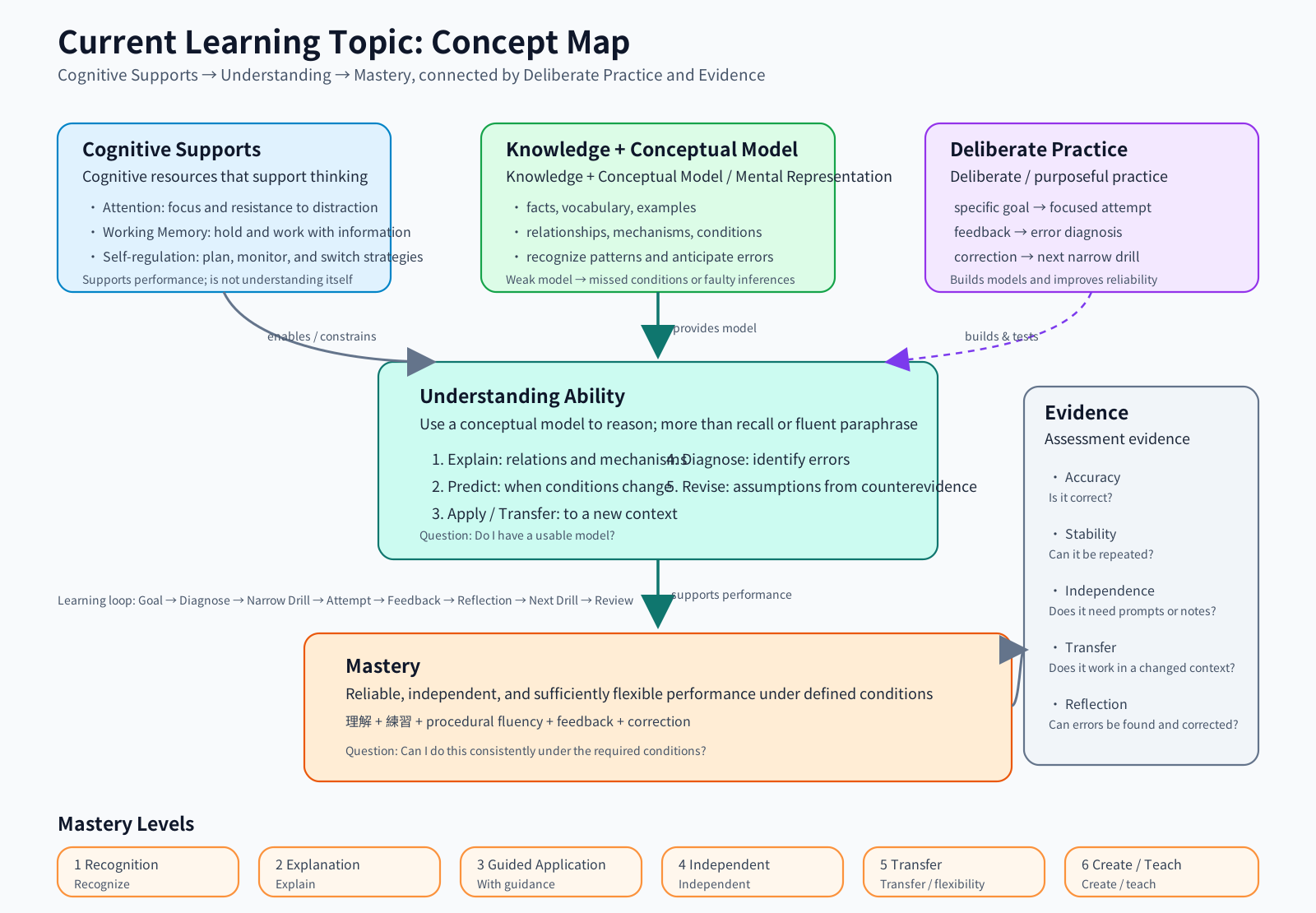
One connected model
1
2
3
4
5
6
7
8
9
10
11
12
13
14
15
16
17
Cognitive supports ── enable / constrain ──┐
                                           │
Knowledge + conceptual model ──────────────┼─> Understanding ability
                                           │       ├─ explain
                                           │       ├─ predict changed cases
                                           │       ├─ apply / transfer
                                           │       └─ diagnose errors and revise assumptions
                                           │
Purposeful practice + feedback ── builds ──┘
                 │
                 └─> reliable performance under defined conditions = Mastery
                         ├─ recognition
                         ├─ explanation
                         ├─ guided application
                         ├─ independent proficiency
                         ├─ transfer / flexible mastery
                         └─ creation / teaching
The concepts and their links
1. Cognitive supports
Attention, working memory, and executive control / self-regulation help a learner focus, hold conditions in mind, plan, monitor, and change strategy. They affect how easily a learner can process and express ideas.
They are supports, not proof of understanding. Strong memory or concentration can coexist with definition-only recall.
2. Knowledge and conceptual model
Facts, vocabulary, examples, relations, and mechanisms form the material from which the learner builds a conceptual model (also called a mental representation). A weak or incomplete model leads to omitted conditions, incorrect causal inferences, and weak transfer.
3. Understanding ability
Understanding is demonstrated by using a model rather than simply repeating information. The current working tests are:
- Explain a relationship or mechanism.
- Predict what changes when conditions change.
- Apply / transfer the relation to a new case.
- Diagnose and revise an assumption after error or counterevidence.
This makes understanding a bridge between stored knowledge and performance.
4. Mastery
Mastery is reliable, independent, and appropriately flexible performance for a defined class of tasks. It normally draws on understanding, but it also needs practice, procedural fluency, feedback, and correction.
A learner may understand a principle but lack mastery if performance is slow, inconsistent, prompt-dependent, or limited to one familiar example.
5. Mastery levels
| Level | Core evidence |
|---|---|
| Recognition | Identifies a word, rule, method, or example. |
| Understanding / explanation | Explains the main relation or reason. |
| Guided application | Uses the idea with a model, prompt, or worked example. |
| Independent proficiency | Performs typical tasks accurately and repeatedly without prompts. |
| Transfer / flexible mastery | Adapts the idea to unfamiliar, changed, or complex situations. |
| Creation / teaching | Diagnoses errors, compares methods, improves an approach, and teaches it. |
6. Evidence criteria
Do not infer a level from confidence or one correct answer. Check:
- Accuracy — is the result correct?
- Stability — is it repeatable?
- Independence — does it require prompts or notes?
- Transfer — does it survive a changed situation?
- Reflection — can the learner find and repair a relevant error?
7. Deliberate-practice loop
Goal → diagnose → narrow drill → attempt → feedback → reflection → next drill → review
The loop improves both the learner’s model and the reliability of their performance. Feedback reveals the earliest failed step; targeted practice then strengthens a specific weak link.
Diagnostic questions
When a learning task goes badly, separate possible causes:
- Is necessary knowledge, vocabulary, or a conceptual model missing?
- Is attention, working memory, or self-regulation overloaded?
- Is the learner at a lower mastery level than the task demands?
- Is a condition or causal variable being treated as fixed when it is not?
- What smallest drill would distinguish these explanations?